
The ENG256B course, a course about digital humanities, opened my eyes to a new concept; digital humanities. I have always assumed that any English course would require old fashioned methods of analyzing texts, such as close reading hard copies of books and writing physical essays or reports n our analysis. However, this course showed me that text analysis can go as far as not having to read the actual text we are analyzing. And what I mean by that is that we can input our data or text into several digital tools that will make our analysis easier.
Throughout the semester, we were introduced to many digital humanities tools that helped us with our project. Most of these tools were easy to use, however some of them required extended guidance from our professor to learn how to properly interact with them.
As a start, I will talk about one of my favorite tools that me and my partner used for distant reading; Voyant Tools. Voyant Tools is a web-based application for text analysis. We employed this tool for distant reading of the poems of William Blake, who was the topic of our digital timeline project. Voyant Tools proved to be an efficient way to determine the central theme of the poems and give us a greater insight about them. Voyant tools had a nice feature, the cirrus, which showed the most frequent words appearing in a text or a group of texts. It also had a tool that graphed the trends in which these words appeared throughout the text or full corpus. These features were super helpful in our analysis of the condensed poems of William Blake.

However, Voyant Tools was not very user friendly. The service was slow to process multiple texts in our corpus and the cirrus would not update itself on the addition of new poems.
Other tools that we used for our project were the mapping tools Google My Maps and Topotext. For Google My Maps, we pinpointed significant locations in the author’s life and labelled them. We could add different layers to the map, each representing a different phase in the author’s life. To map the locations in one of Blake’s poems, we used Topotext which is a mapping tool developed by students who also studied at AUB. Topotext is a smart digital tool that gathers all the times any location was mentioned in a text and allows you to edit out any undesired or falsely collected locations. I didn’t encounter any difficulties when using either of these tools.

Using TimelineJS to implement our project was relatively easy. TimelineJS has predefined functionalities and only requires data input into prelabeled spreadsheet cells. TimelineJS allowed me and my partner to put together a creative and visually stimulating digital tmeline about Blake.However, it does not provide a lot of room for customization.
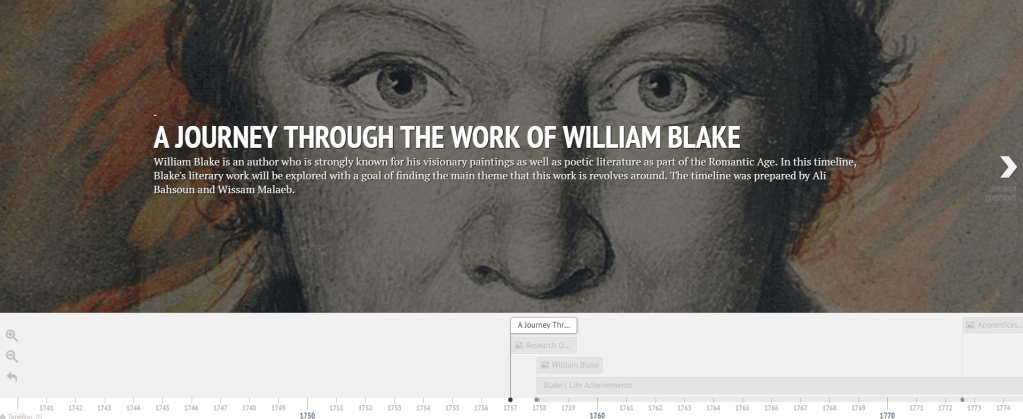
For our project we first had to find the data to analyze using the tools mentioned before. We were provided with links to several websites that contained sources that we could use. However, it was slightly hard to find texts and poems for out author since they were published in the 1800’s and digital copies of them were not always available. With some more searching around the web we were able to find enough texts for our analysis.

This course also required the use of Twitter. A task that I found a little bit difficult was finding relevant things to tweet about. Being a non-regular twitter user, I got to explore twitter more and experience a new side of social media. I am glad to say that twitter is now of more interest to me than it was before.
You can follow me on my twitter account below!
And lastly, the most enjoyable thing for me I feel was documenting my experience in this course by blogging about it on here. WordPress proved to be very user friendly, and made my first blogging experience worthwhile.

This course was unlike any other I took during my four years at AUB. It was very interesting to look at humanities from a digital perspective, and work with DH tools that introduced me to a new concept of distant reading. I encourage anyone considering to register this course to do it since it is both very interesting and rewarding.
 Wissam's Blog